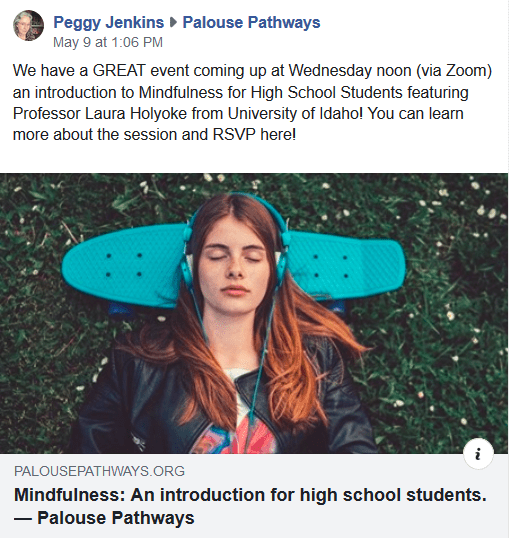
We have a GREAT event coming up at Wednesday noon (via Zoom) an introduction to Mindfulness for High School Students featuring Professor Laura Holyoke from the University of Idaho! You can learn more about the session and RSVP here!
I ran across this video a while back and it impressed me as being full of wisdom. If you are a horse person, you will nod in agreement, and yet learn some new things as well. Enjoy!
Schools chief Sherri Ybarra discussed distance learning strategies with Sal Khan and other education and technology officials Wednesday.
Ybarra didn’t take any action or mandate Idaho school officials follow any particular programs or examples. But she did say it was important to share good ideas and leverage partnerships to improve teaching during the coronavirus pandemic.
“As you know, we’ve had to move to a statewide distance learning model due to Covid-19 and we’ve seen some really great, creativity, innovation and resourcefulness among our parents and our teachers and our schools leaders,” Ybarra said. “But despite all this we’ve also encountered some challenges and some obstacles as we’ve had to make this transition.”
Sal Kahn participated in an Idaho State Department of Education distance learning webinar Wednesday.
Khan is the founder of the non-profit Khan Academy that offers online lessons and reaches 20 million students a month. Before the Covid-19 pandemic, Khan said technology will always be secondary to good teachers. But technology can help good teachers reach more students or do more with instruction.
“I’ve always said if I had to pick between an amazing teacher and amazing technology I would pick the amazing teacher every time,” Khan said. “But the ideal is not having to pick and having the amazing technology empower the amazing teacher.”
Ybarra and the State Board of Education are working towards buying a statewide learning management system that could push content and lessons out to students as well as share communication information and resources with families. During meetings this week, Ybarra said she wants the new system to be opt-in instead of mandated.
Ybarra also said Idaho lags behind other states and school districts when it comes to online learning management systems and stressed that it will be important and challenging to ensure all families have devices and Internet connectivity.
Here are snapshots of the online learning experiences:
Lee County, Florida:
Students were on spring break in mid-March when the governor announced they would close schools for two weeks, a closure that ended up being extended through the end of the year.
The district already had a 1:1 device ratio at the secondary level, but not the elementary. The district developed a continuity plan, reached out to families and distributed 15,000 Chromebooks over three days. Then schools allowed students to sign up for free internet offered by a local provider and the district purchased 10,000 internet hotspots, which it distributed to both students and teachers who faced connectivity gaps.
District officials also developed a plan to count attendance once a week based on assignments that are completed, Zoom meetings or other contact with students. Attendance increased to 99 percent over the past two weeks, K-5 curriculum director Bethany Quisenberry said.
“Moving to distance learning was an experience to say the least,” she said.
The district uses the iReady learning management system.
Yuma Union High School District, Arizona:
Yuma has had a 1:1 device ration for about 10 years. But officials did not invest in professional development training for educators that would have to work with the devices and platforms. That was a difficult mistake, Superintendent Gina Thompson said.
“We got the stuff without the adult learning that needed to come with it, and it’s just critical,” she said. “We’ve now such an amazing team as far as teachers for the adults. That has exponentially helped us through this particular time with Covid-19.”
Thompson said Yuma officials count themselves lucky they realized their mistake and got training in place before this year’s disruptions.
“From the time of Covid-19 and the first week of posting assignments… 100 percent of our teachers have their lesson posted,” Thompson said.
Interestingly, Yuma uses Canvas as its districtwide LMS, and does not allow schools to opt-in or opt-out, which Thompson described as the right call. “We have much more robust tracking of data,” Thompson said.
Looking ahead
Ybarra said she and her staff are planning to invite Idaho superintendents to discuss their distance learning strategies during an upcoming webinar.
The tables are turning and students will begin passing out the grades in every Idaho school this year.
That’s because student feedback will become an important part of the state’s new school accountability system.
How often do your teachers seem excited to be teaching your class?
How often do you worry about violence at your school?
As part of the effort to comply with the federal Every Student Succeeds Act, state officials chose to create a student engagement survey to help measure school quality and climate.
Debbie Critchfield
All public school students attending third through 12th grade will take short, online surveys this spring using the same technology they use to take online tests, State Board of Education Vice President Debbie Critchfield.
And what students say will actually matter.
After the surveys are complete, state officials will publicly share the summarized and aggregated data —without identifying students — broken down to the district and school level.
Local schools will have access to more detailed reports with all students’ responses.
“As policymakers and legislators (the survey data) will help inform decisions on general education topics,” Critchfield said. “But the real value will be in the (students’) local building, where the data can impact student achievement. There, (the data) are more than just number, they will be able to make adjustments.”
State officials are developing a similar parent survey that they plan to roll out the following year, in 2018-19.
The student survey questions will cover several different themes:
School safety.
Student-teacher relationships.
School climate, meaning a student’s perception of the overall social and learning climate of the school.
Additionally, students in grades 9-12 will receive another set of questions on the topic of “grit,” or the ability to persevere through setbacks to achieve important long-range goals.
Questions will also be geared toward a students’ grade level.
“You’re not going to ask a 12th-grader the same questions as a third-grader,” Critchfield said.
Karlynn Laraway, the State Department of Education’s director of assessment and accountability, said launching the survey this year would cost the state less than $20,000. She said the state has permission to use the already-developed Panorama Student Survey and administer it to students using the American Institutes for Research technology platform that Idaho students already use to take assessment tests each spring.
That saved the state money not having to develop its own survey questions or develop a new mechanism to send the survey out, Laraway said.
Students in grades three through six will answer 12 questions, while older students will receive 15 questions.
Some of the questions an elementary school student will receive include:
How often do your teachers seem excited to be teaching your class?
How often do you worry about violence at your school?
Students may answer “almost never,” “once in a while,” “sometimes,” “frequently,” or “almost always.”
Some questions students in grades six through 12 include:
How often do you stay focused on the same goal for several months at a time?
How often do you worry about violence at your school?
Critchfield and Laraway said they wanted to publish and disclose the survey well before it reaches students to add a degree of transparency to the project.
“This isn’t secret; we don’t want anybody’s first exposure to this to be when their child takes the survey,” Critchfield said. “There are no right or wrong answers, and it is not there to trick anybody.”
Anybody with questions or concerns about the student engagement survey may email Allison Westfall with the State Department of Education or Blake Youde with the State Board of Education.
Members of the State Board of Education chose to include student and parent surveys in the state’s ESSA plan, while officials from several other states chose other metrics, such as chronic absenteeism or teacher attendance.




 Books & Ed Tech Trends